
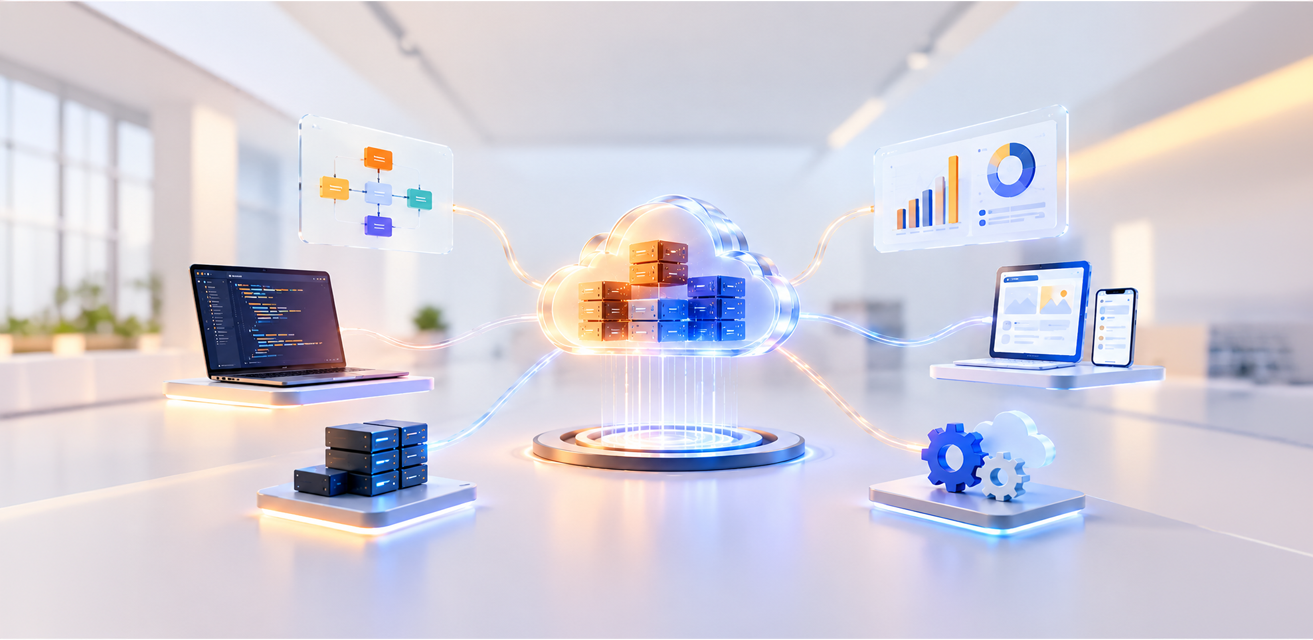
Application development is evolving as businesses demand faster releases, better user experiences, stronger security, and greater scalability. Yet many organizations continue to operate legacy applications that are difficult to maintain, expensive to upgrade, and challenging to integrate with modern technologies. These limitations can slow innovation and prevent IT teams from responding effectively to changing business requirements.
Amazon Web Services (AWS) provides cloud infrastructure, development tools, and managed services that help organizations modernize their application development processes. From cloud-native architecture and DevOps automation to serverless computing and application monitoring, AWS enables businesses to build, deploy, and manage applications more efficiently.
However, successful AWS application modernization involves more than migrating workloads to the cloud. It requires a clear strategy for improving application architecture, simplifying development workflows, strengthening security, and aligning technology investments with business objectives.
Why Organizations Need to Modernize Application Development
Traditional application environments often rely on tightly connected components, manual deployment processes, and infrastructure designed around older business requirements. As applications grow, these limitations can affect development speed, system reliability, and operational efficiency.
Common challenges include:
Complex legacy architecture
Older applications may contain dependencies that make updates difficult and increase maintenance effort.
Slow software releases
Manual testing and deployment processes can delay new features and bug fixes.
Limited scalability
Fixed infrastructure may struggle to accommodate changing workloads or unexpected demand.
Integration difficulties
Legacy systems may require additional effort to connect with modern APIs, databases, and digital platforms.
Security and monitoring gaps
Inconsistent controls and limited visibility can make it harder to identify risks and resolve operational issues.
AWS application modernization helps organizations address these challenges through flexible infrastructure, managed cloud services, and modern software engineering practices. The right approach depends on the application's current limitations, business priorities, and long-term requirements.
Modernizing Legacy Applications with AWS Cloud-Native Architecture
Moving an application to the cloud does not automatically make it modern. Organizations must also consider whether the existing architecture supports maintainability, scalability, and future development.
AWS supports several application modernization strategies, including rehosting, replatforming, refactoring, and rearchitecting. Businesses can select an approach based on the complexity of their applications and the level of change required.
For example, an enterprise application that combines order processing, inventory management, and customer notifications in a single system may become difficult to update. Separating suitable functions into independent services can help development teams make targeted changes without modifying the entire application.
Services such as Amazon Elastic Container Service (Amazon ECS), Amazon Elastic Kubernetes Service (Amazon EKS), and AWS Fargate support containerized application deployment and management.
With appropriate architecture and integration planning, organizations can improve deployment flexibility, simplify maintenance, and create a foundation for continuous application improvement.
Accelerating Software Delivery Through AWS DevOps Automation
Modern application development requires a reliable process for moving code from development to production. Manual deployments, inconsistent environments, and repetitive testing can introduce delays and increase the possibility of errors.
AWS DevOps capabilities help organizations automate selected stages of the software delivery lifecycle. AWS CodePipeline supports workflow orchestration, AWS CodeBuild provides build and testing capabilities, and AWS CloudFormation enables infrastructure to be defined through reusable templates.
Consider a business that releases application updates across development, testing, and production environments. A structured CI/CD pipeline can automate builds, run tests, and execute defined deployment steps, reducing repetitive manual work.
Organizations can also integrate code quality checks, security validation, and approval processes into these workflows.
The result is a more consistent software delivery process that allows development teams to focus on functionality, reliability, and customer needs rather than repetitive operational tasks.
Building Scalable Applications with AWS Serverless Computing
Application workloads can change throughout the day, during seasonal campaigns, or when businesses introduce new services. Traditional infrastructure planning may require additional capacity to handle peak demand, even when that capacity remains underused during quieter periods.
AWS serverless computing offers an alternative for suitable workloads. AWS Lambda runs code in response to events without requiring organizations to manage the underlying servers directly. Amazon API Gateway helps teams create and manage APIs for connecting application components and external systems.
For example, an application that processes customer documents could trigger a function when a new file arrives, perform a defined operation, and store the result. This event-driven approach can reduce the need to maintain continuously running processing infrastructure for intermittent tasks.
When designed appropriately, serverless applications can simplify infrastructure management and accommodate changing demand. Organizations should still evaluate execution limits, latency requirements, integration dependencies, and cost patterns before selecting this architecture.
Strengthening Application Security Throughout Development
Security is an essential part of modern application development. Applications interact with users, APIs, databases, cloud resources, and external systems, creating multiple areas that require protection.
AWS provides services that help organizations establish access controls, monitor activity, and identify potential security threats. AWS Identity and Access Management (IAM) supports permission management, AWS CloudTrail records account activity, and Amazon GuardDuty helps detect potentially malicious behavior.
These capabilities should complement secure coding practices, encryption, vulnerability assessments, dependency checks, and controlled deployment procedures.
Organizations must also understand the AWS shared responsibility model, which defines how security responsibilities are divided between AWS and its customers according to the services and configurations used.
By incorporating security checks throughout development and deployment, businesses can identify risks earlier and establish more consistent protection as applications evolve.
Improving Application Performance with Cloud Monitoring
Application modernization does not end when software reaches production. Teams need visibility into application behavior to identify performance issues, investigate failures, and maintain reliable user experiences.
Amazon CloudWatch supports monitoring through metrics, logs, and alarms. Combined with appropriate application instrumentation and distributed tracing, these capabilities help engineering teams investigate issues across connected services.
For example, if a business application experiences slow transaction processing, monitoring data can help engineers determine whether the problem relates to compute resources, an API, a database query, or an external dependency.
This visibility supports informed decisions about application design, infrastructure utilization, and operational improvements.
By connecting monitoring insights with development priorities, organizations can make continuous improvements based on actual application behavior rather than assumptions.
Creating an Effective AWS Application Modernization Strategy
Successful modernization begins with a structured assessment of existing applications, technical dependencies, business priorities, security requirements, and operational costs.
Organizations can follow these steps to establish a practical modernization roadmap:
Assess the current environment
Identify legacy constraints, performance bottlenecks, integration challenges, and maintenance risks.
Choose the right modernization approach
Determine whether applications should be rehosted, replatformed, refactored, or rearchitected.
Prioritize business-critical improvements
Select applications where modernization can address significant operational challenges or support strategic goals.
Validate the proposed architecture
Test functionality, performance, security, integration, and expected costs before wider implementation.
Automate development workflows
Introduce suitable CI/CD pipelines, infrastructure-as-code practices, and repeatable deployment processes.
Measure and optimize continuously
Track deployment performance, application reliability, recovery time, resource utilization, and operating costs.
A phased modernization strategy allows organizations to manage risk, validate results, and expand successful practices across their application portfolio.
How Vithi IT Supports AWS Application Modernization
Modernizing applications requires a balance between technical capabilities and business priorities. Organizations need to understand their existing environments, identify improvement opportunities, and select cloud solutions that address specific operational requirements.
Vithi IT's AWS Cloud Solutions services provide a starting point for businesses exploring cloud transformation, application modernization, and infrastructure optimization.
With a clearly defined modernization strategy, organizations can work toward more adaptable application architectures, streamlined development processes, improved operational visibility, and sustainable cloud operations.
Explore Vithi IT's AWS Cloud Solutions to learn more about its cloud services: https://vithiit.com/digital-transformation-services/aws-cloud-solutions